viernes, 9 de noviembre de 2012

Memoria histórica en Phnom Penh / Historical memory in Phnom Penh


Todxs hemos oído hablar alguna vez de los jemeres rojos y de las atrocidades que cometieron entre 1975 y 1979. Como esa información es bastante accesible queremos centrarnos en cómo se está tratando la memoria histórica de este oscuro episodio de la historia camboyana.

Dos sitios son clave para comprender como la sociedad se sigue recuperando de este trauma; el S-21 y los campos de la muerte (Killing Fields).

Fotografías de detenid@s en S21.

Tuol Sleng o S-21 fue el nombre que se le dio a un colegio convertido en prisión por los jemeres rojos en la ciudad de Phnom Penh. A pesar de que en ese lugar se cometieron las mayores atrocidades la visita invita a la reconciliación. Puesto que lxs sospechosxs eran detenidxs con toda su familia (embarazadas, niñxs, mayores, enfermxs, discapacitadxs…), en esta cárcel se torturó indiscriminadamente. Electroshocks, extracción de uñas y dientes, ahogamientos, golpes con varas de bambú, palizas… de todo.

Fotografía de una mujer con su bebé ingresando en S21.

Sin embargo cuando se avanza en la visita ver un documental muy interesante. En este vídeo tiene lugar el encuentro de uno de los pocos supervivientes con uno de los guardas de la prisión. Además hay una parte dedicada a lxs más jóvenes, que aunque sirvieran a los jemeres rojos, también son consideradxs víctimas. Para todxs estxs niñxs soldado la reinserción en la sociedad fue extremadamente difícil.

Una de las celdas de la prisión.

Algo que nos desconcertó fue que en el patio de la escuela/cárcel uno de los siete supervivientes que se encontraron al liberar la capital estaba vendiendo su libro. Si bien es verdad que hay una importante literatura de víctimas, nos chocó ver que ese hombre, que tanto había sufrido en S-21 se pasara allí sus días.

Preso de Tuol Sleng.

El segundo lugar para la memoria se encuentra a 15 kilómetros de la ciudad de Phnom Penh y es conocido como los campos de la muerte, uno de los múltiples lugares que se escogieron para matar indiscriminadamente.

Una de las características del régimen jemer fue el traslado forzoso de gente desde los núcleos urbanos hacia el campo. El objetivo era ampliar la superficie cultivada y no les importó esclavizar a la población para lograrlo. Todas las personas consideradas sospechosas o culpables acababan asesinadas en los campos de la muerte. Como no querían gastar balas mataban a la gente a golpes.

Una buena referencia es la película de 1984 “The Killing Fields”, dirigida por Roland Joffé. Se trata de una excelente forma de acercarse a la realidad que vivieron muchas personas en Camboya. Hay que verla.


We’ve all heard about Khemer Rouge and the atrocities they committed between 1975 and 1979. Because that information is easily accessible we want to focus on how the historical memory of this dark episode of Cambodia’s history is being dealt with.

Two places are key to understand how the society is still trying to recover from this trauma; S-21 and the Killing Fields.

Tuol Sleng or S-21 is the name given to school that became a prison for the Khemer Rouge in Phnom Penh. Despite the fact that it was precisely there where the biggest atrocities were committed the visit invites to reconciliation. Because the suspects were arrested with all their family (pregnant women, children, old people, sick and handicapped…), in this prison people were tortured indiscriminately. Anything you could imagine, electrical shocks, pulling of nails and teeth, drownings, beatings…

However, as the visit continues you can watch a very interesting documentary. In this video one of the few survivors meets one of the prison’s guards. Moreover there is a part dedicated to the youngest one, who even if they served the Khemer Rouge are considered to be victims too. For all these soldier children getting back again into society was extremely hard.

We were bewildered because in the prison-school’s courtyard one of the seven survivors that were found in the prison was selling his book. Although there is an important victim’s literature, we were shocked to see this man, who had suffered so much in the S-21, spend there his days.

The second place for remembering is located fifteen kilometres away from Phnom Penh and it is known as the Killing Fields. It is one of the multiple places chosen to kill indiscriminately.

One of the Khemer Rouge regime’s characteristic was the massive forced relocation of the people from the cities into the countryside. The goal was to increase the land for agricultural purposes and they enslaved the people in order to do so. All the people who were considered suspects or guilty ended up being assassinated in the killing fields. Because they wanted to save bullets they beat the people to death.

A good reference is the film “The Killing Fields”, directed in 1984 by Roland Joffé. It is an excellent way to approach the reality that many Cambodians lived. You have to see it.

jueves, 8 de noviembre de 2012

Tramitar el visado indio en Phnom Penh / Indian visa application in Phnom Penh


Nuestra siguiente parada después de Camboya es Birmania, por lo que tramitamos el visado con tiempo (dos meses antes) en Vientiane. Fue muy fácil y rápido, cosa que nos sorprendió conociendo las dificultades que sufren las personas que quieren visitar el país, donde todo parece ser muy complicado.

En la misma línea, hemos querido tramitar el visado indio en Phnom Penh con más de un mes de antelación. No ha sido ni fácil ni rápido.

El 26 de octubre nos presentamos inocentemente en la embajada de la India para hacer los papeles. Tras esperar un buen rato, una chica que estaba haciendo su visado nos explicó que teníamos que completar el formulario online y obtener una cita. A ella le dieron la cita para dentro de cinco días.

De vuelta en el hotel rellenamos el formulario y obtuvimos una cita… para el 2 de noviembre. Esto explica que hayamos pasado ocho días en la capital camboyana.

Llegado el gran día, nos presentamos en la embajada con el formulario impreso, la foto, y las fotocopias pertinentes. La cita era a las diez de la mañana; nos atendieron pasadas las doce.

Aunque el coste del visado es de 40USD, las personas no camboyanas deben pagar 17 dólares extra para que envíen un fax a nuestra embajada comprobando que no somos terroristas.

La fecha de recogida que os dieron fue el 7 de noviembre. Total, casi dos semanas para hacer el visado en un país con muy poca población y menos solicitudes. En las horas que pasamos en la embajada nunca vimos a más de cuatro personas.

En el ínterin nos hemos marchado a Siem Reap para visitar los templos de Angkor. Cuando regresamos ayer a  Phnom Penh no tenían el visado pues estaban a la espera de la respuesta española.

Preocupad@s porque tenemos que estar en Bangkok en cinco días, preguntamos qué opciones teníamos. Hablamos con el jefe. Nos dijo que no nos preocupáramos, que había tiempo. “Volved el viernes”. “El viernes cerramos”, dijo el conserje. “Entonces mañana”.

Así que hoy hemos vuelto y por fin tenemos nuestros visados, yuhuuuuuuuu.


Our next stop after Cambodia is Burma, so we applied for our visa with enough time (two months before) in Vientiane. It was very straight forward and fast, something that surprised us knowing the difficulties anyone visiting Burma faces at some point or another

Likewise, we wanted to apply for the Indian visa in Phnom Penh with more than one month in advance. It hasn’t been neither easy nor fast.

On the 26th of October we presented ourselves very innocently to do the paperwork. After waiting for a while, a girl that was doing her visa explained to us that we had to fill in an online application form to obtain an appointment. She had to wait for five days for the appointment date.

Back in our hotel we filled in the application form and we got our appointment… for the 2nd of November. This is the reason why we stayed eight days in Cambodia’s capital.

When the big day came, we went to the embassy with the printed form, the passport picture and the required photocopies. The appointment was for ten in the morning; they attended us well after twelve.

Despite the fact that visa costs 40USD, non-Cambodian people have to pay 17 extra dollars so they can send a fax to our embassy in order to confirm that we aren’t terrorists.

We were supposed to pick up our visa on the 7th of November. A total time of two weeks to obtain a visa in a sparsely populated country with even less applications. During the time we spent in the embassy we never saw more than four people.

In the meantime we left for Siem Reap to visit the Angkor temples. Yesterday, when we came back to Phnom Penh they didn’t have our visa because they were waiting a reply from the Spanish embassy.

We were worried because we have to be in Bangkok in five days, we asked what options we had. We spoke with the boss. He told us not to worry, that there was enough time. “Come back on Friday”. “We are closed on Friday”, the janitor said. “Tomorrow then”.

So today we have gone back again and we finally our visas, hurraaaaaay.

martes, 6 de noviembre de 2012

Separarse es muy duro / Getting separated is hard


Llegado el momento, separarse es muy duro. En Phnom Penh pusimos un anuncio en el foro de la Lonely Planet para vender nuestras queridas bicicletas. Salió muy bien pues al día siguiente una chica estaba interesada. Vendimos la bici de Andrea por 150 USD.

Intentamos vender la de Alvaro en el Grasshopper’s, una tienda de bicis de segunda mano especializada en tours por el sudeste asiático. Tenían hasta tours por Bután. El problema fue que eran muy careros vendiendo las bicis, y muy roñosos comprándolas.

Pero no desistimos y fuimos directamente a la tienda Giant. Rápido, fácil, y justo. El encargado dijo: “Nueva son 200 USD, te la compro por 100”. Estupendo, nos costó fingir que nos lo pensábamos.

Al final nos ha salido muy bien; pagamos 280€ y hemos recuperado 200€. Además hemos hecho lo que más nos gusta: viajar en bici.


When the moment came, getting separated was hard. In Phnom Penh we posted an advertisement in the Lonely Planet forum to sell our dear bicycles. It turned out really good, the next day a girl was interested. We sold Andrea’s bicycle for 150 USD.

We tried to sell Alvaro’s in Grasshopper’s, a second hand bicycle shop specialized in tours around South East Asia. They even have tours in Bhutan. The problem was that they were pricy selling the bicycles and very stingy buying them.

But we didn’t give up and headed directly to the Giant shop. Fast, easy, and fair. The manager said: “New it’s 200 USD, I’ll give you 100”. Awesome, it was hard to pretend that we were thinking about it.

Finally it has been a good deal; we paid 280€ and we’ve gotten back 200€. Besides, we’ve done the thing we most enjoy: travel by bicycle.

domingo, 4 de noviembre de 2012

Celebra tu cumpleaños en Phnom Penh / Celebrate your birthday in Phnom Penh


Como sabéis hace unos días ha sido el cumpleaños de Andrea, y lo hemos celebrado a lo grande. Primero, porque cumplía un cuarto de siglo (el primero de muchos). Y segundo, porque ha sido su primer cumpleaños sin frío.

Os lo contamos en cinco pasos.

1- Cenar en un restaurante de Corea del Norte. Esta ha sido una de las experiencias más bizarras de nuestro viaje, por el personal, el espectáculo y la comida. Las personas que trabajan en estos restaurantes son casi las únicas que salen de su país. Como visitar Corea del Norte es difícil y caro, esta es una de las raras ocasiones en las que es posible interactuar con norcorean@s.


Nuestra camarera, muy amable, participaba junto con las otras en el espectáculo. El show se compone de música en directo, danza que suponemos será tradicional (aunque vimos castañuelas), y trajes muy llamativos. Duró aproximadamente una hora y nos dejó con la boca abierta.

Ummmm, rico perrooooo

La comida también es especial. El plato estrella: perro guisado. Como eran trozos de carne podían haber sido de ternera (estaban muy tiernos), y el guiso estaba bueno. Lo acompañamos con noodles fríos, tortitas de calabaza y ternera salteada con verduras. De beber, soju, el licor típico.


A pesar de ser un poco caro (pagamos 10€ por persona), merece la pena adentrarse  en el extraño universo de Corea del Norte.


2- Tratamiento en un spa. Si algo hay en el Sudeste Asiático son masajes a precios de ganga. Por menos de 5€ cada un@ nos dimos un masaje tradicional de hora y cuarto en un elegante spa con música relajante y perfumes florales. Además, la cumpleañera se hizo una manicura y pedicura por unos 4€ (lo acompañan de un breve masaje).


3- Comer en el restaurante de la ONG Friends (Child Safe). Este restaurante tiene como objetivo proporcionar a jóvenes desfavorecid@s una formación en el mundo de la hostelería. También tiene otros proyectos como salones de belleza e incluso una tienda con objetos realizados a partir de materiales reutilizados. El menú está compuesto por tapas creativas que rondan los 3€. Comimos estupendamente por una buena causa, que más se puede pedir.


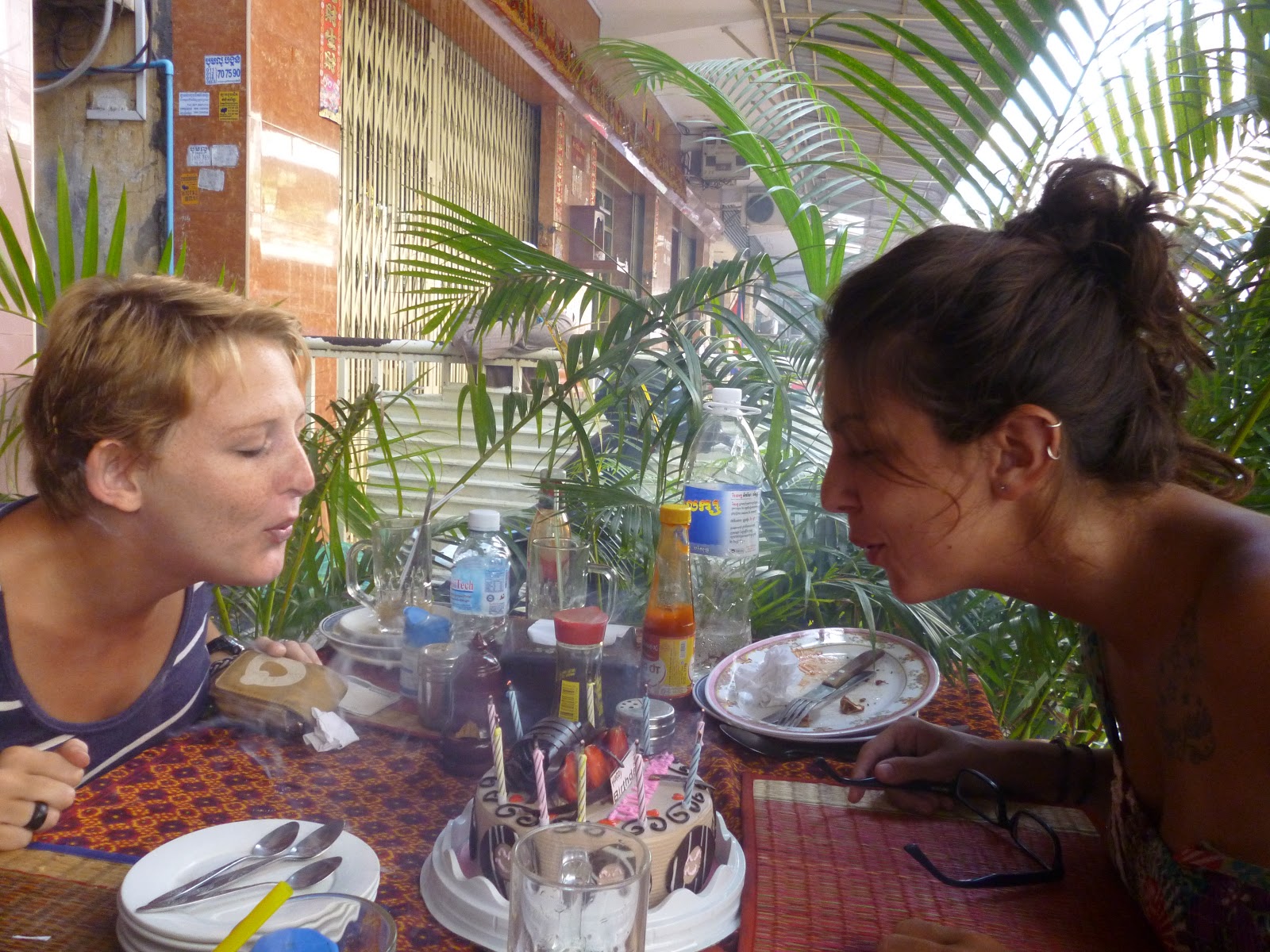
4- De postre, tarta. Como el cumpleaños de Talia fue dos días antes, los chicos se encargaron de sorprendernos con una rica tarta y velas de las que no se apagan.


5- Darse un chapuzón. Este año he tenido un cumpleaños muy especial pues ha sido el primero en toda mi vida en el que he pasado calor. Tanto, que nos fuimos a la piscina.


Todo esto ha sido posible gracias a Alvaro, que siempre sabe cómo hacerme sonreír.


Like you already know it's been Andrea’s birthday a few days ago, and we have celebrated it in a big way. First, because she became a quarter of a century old (the first of many). And secondly, because it has been her first birthday without cold.

We will tell you about it in five steps.

1- Having dinner in a North Korean restaurant. This has been one of the weirdest experiences of our journey, due to the personnel, the show and the food. The people who work in these restaurants are one of the few that ever leave their country. Because visiting North Korea is difficult and expensive, this is one of the rare occasions in which it is possible to interact with North Korean people.

Our waitress, very kind, participated together with the others in the show. The show is a mixture of live music, dances which we suppose are traditional (even if we saw castanets), and very gaudy dresses. It lasted for about an hour and it was jaw-dropping.

The food is also special. The star dish: dog broth. We ate pieces of meat so it could have been beef (they were very tender), and the broth was good. We accompanied it with cold noodles, pumpkin pancakes and stir fried beef with vegetables. For drink, soju, the typical liquor.

Despite being a bit pricey (we paid ten euros per person), the experience of entering in North Korea’s weird universe is worth it.


2- Treatment in a spa. If there is something you can find everywhere in South East Asia is a cheap massage. For less than five euros each we enjoyed 75 minutes of massage in an elegant spa with relaxing music and floral fragrances. Moreover, the birthday girl had a manicure and a pedicure done for around four euros (accompanied with a short massage).


3- Eating in NGO Friends’s (Child Safe) restaurant. This restaurant has as its main goal to provide jobs for disadvantaged youths in the hospitality sector. It also has other projects such as beauty salons and a shop with articles made out of reused materials. The menu is made out of creative tapas that cost around three euros. We had a fantastic meal for a good cause, what else can you ask for?


4- For dessert, a cake. Because Talia’s birthday was two days before, the guys decided to surprise us with nice cake and candles that don’t blow out.


5- Go swimming. This year I’ve had a very special birthday because it has been the first one in my whole life in which the weather has been hot. So hot, that we went to a swimming pool.


All of this has been possible thanks to Alvaro, he always knows how to make me smile.

sábado, 3 de noviembre de 2012

En Stung Treng no hay nada / There is nothing in Stung Treng


Aunque parezca mentira nos hemos pasado tres noches en Stung Treng. Y como no había nada que hacer hemos estado descansando y pensando.

Desde que cruzamos la frontera notamos un aumento sustancial de las temperaturas con las que es imposible (o extremadamente desagradable) pedalear. Además nos estábamos quedando sin tiempo; el 12 de noviembre volamos a Yangon, Birmania.

Con mucho pesar hemos decidido coger un autobús a Phnom Penh para vender las bicicletas mientras tramitamos el visado indio.

Entretanto hemos vagado por el impresionante mercado de Stung Treng que apesta a podrido y es el hogar de montones de ratas como gatos. Las mujeres se pasean en pijama estampado de dos piezas (siempre conjuntado) sin importar su edad. Desde luego se las ve muy cómodas.

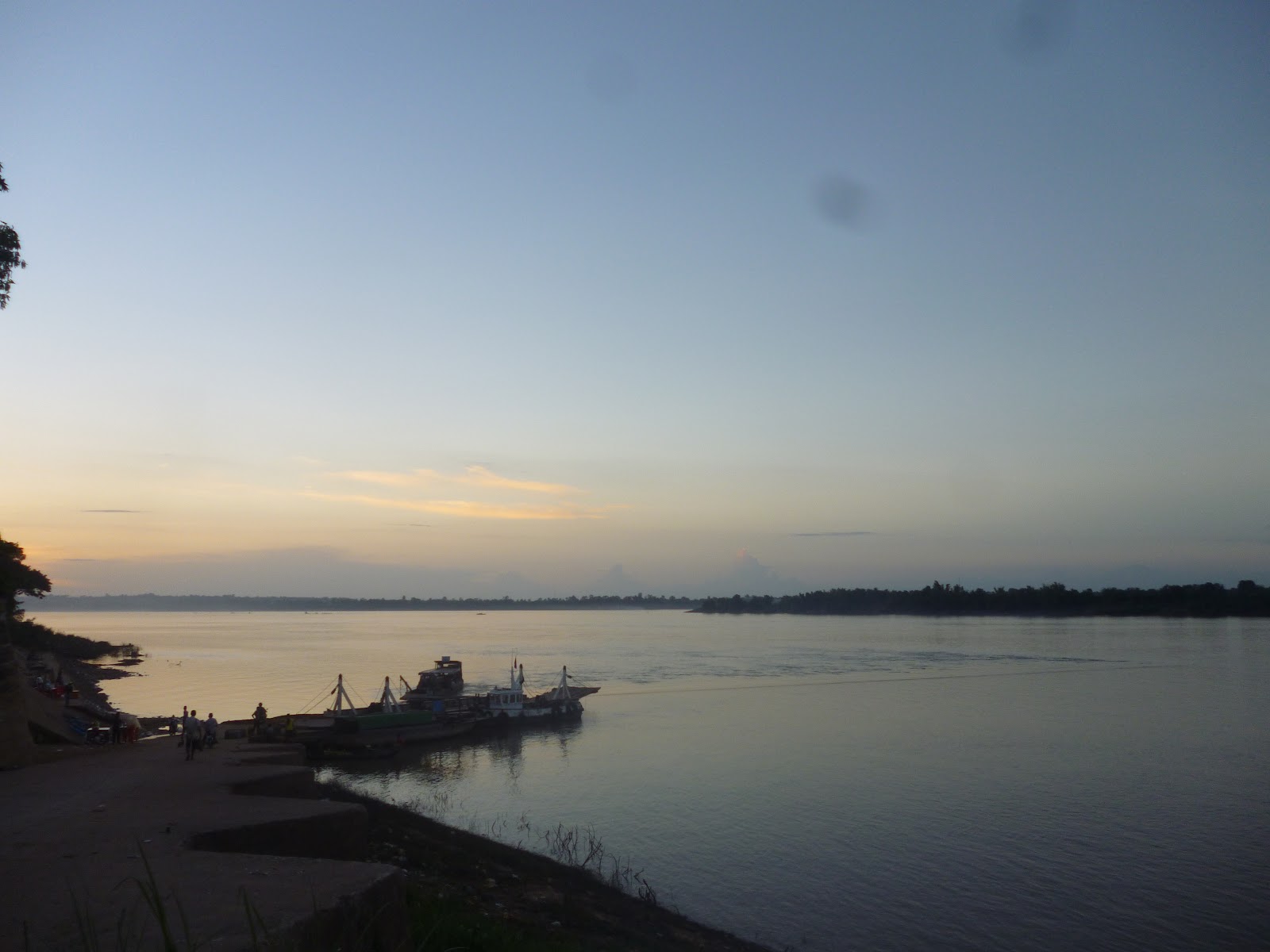
También nos asomamos al río, un afluente del Mekong, cuando caía la tarde.


As crazy as it may sound, we have spent three nights in Stung Treng. And because there was nothing to do we have been resting and thinking.

Since we crossed the border we noticed a substantial increase of the temperatures which makes cycling either impossible or extremely unpleasant. Besides, we were running out of time; the 12 of November we fly to Yangon, Burma.

With great sorrow we have decided to get a bus to Phnom Penh in order to sell the bicycles while we apply for the Indian visa.

In the meantime we have wandered around Stung Treng’s impressive market that stinks really bad and is the home of a bunch of rats as big as cats. The women walk around in matching and colourful pajamas. They seemed to be pretty comfortable.

We also went to see the river, a Mekong tributary, when the sun was setting.

viernes, 2 de noviembre de 2012

Cruzando la frontera de Laos a Camboya / Crossing the Lao-Cambodian border


Salimos de Don Khong en barco rumbo a Ban Nakasang, a 18km de la frontera con Camboya. Ya habíamos odio rumores de las dificultades de cruzar la frontera sin pagar varios impuestos revolucionarios.

Cuando llegamos nos encontramos a Talia y Ricky, con quienes pasamos unos días en la isla. Como ellxs viajan en moto, habíamos quedado en encontrarnos en Stung Treng, la primera población tras pasar la frontera. Resulta que no podían entrar en Camboya con sus motos de matrícula de Laos. Aparentemente esto solo se aplica a lxs extranjerxs, pues lxs naturales de Laos si pueden hacerlo.


Tras estar un rato con ellxs mientras intentaban vender las motos en la frontera, decidieron volverse a las islas en busca de comprador@s.

Cuando fuimos a que nos sellaran el pasaporte para salir de Laos, el listo de turno nos dijo que teníamos que pagar 2 dólares cada un@. Como no le pagamos no nos selló los pasaportes. Nos fuimos muy cabread@s al lado camboyano para pagar el visado de entrada. Oficialmente son 20 dólares, pero se han hecho un cartel y lo han plastificado en el que pone que son 25 dólares por persona (soborno incluido).

Sin embargo, cuando ya nos iban a sellar la entrada en Camboya, se percataron de que no nos habían sellado la salida de Laos, y nos hicieron volver.

De muy mala hostia regresamos al puesto laosiano. El guarda no estaba todavía en la ventanilla cuando Andrea empezó a llamarle de todo y a decirle que quería irse de su país. Insistió en los dos dólares hasta que Andrea, y después yo, empezamos a darle  puñetazos y patadas a la ventanilla mientras nos cagábamos en todo.

Parece que nuestros modales le hicieron entrar en razón y rápidamente nos selló los pasaportes y nos dejó irnos.

De vuelta en el lado camboyano nos sellaron sin problemas.

Todavía nos quedaban más de 65km para llegar a Stung Treng y el calor nos estaba matando. Empezamos a progresar con mejor ritmo al atardecer, parando en los pocos sitios que había a beber algo. Al menos en el norte de Camboya hemos visto que los pueblos son mucho más pobres, y carecen en su mayoría de electricidad. Enfrían las bebidas a la antigua: un cajón con hielo.

En uno de los puestos una señora se empeñaba en enseñarnos una hoja con una foto de la luna con una cara (photoshop puro y duro) diciéndonos que era su rey. Y es que el antiguo rey de Camboya (hace tiempo que abdicó en su hijo) murió en Pekín hace unas semanas. Esa noche vimos cómo la gente miraba a  la luna y saludaban inclinándose. Estaban convencidísimxs de que la cara del difunto rey se reflejaba en la luna.


Se nos hizo de noche a casi 20km de la ciudad, y no teníamos más remedio que seguir, falt@s de dinero y comida. Un motorista nos quiso echar una mano, y nos acompañó hasta Stung Treng dándonos luz con su faro. Tuvimos mucha suerte.


We left Don Khong by boat to Ban Nakasang, 18 kilometres away from the Cambodian border. We had read about the difficulties of crossing the border without paying revolutionary taxes.

When we arrived there we met Talia and Ricky, with whom we had spent some days in the island. Because they travelled by motorbike, we had planned to meet in Stung Treng, the first town after the border. But they couldn’t enter into Cambodia with their motorbikes with a Laotian license plate. Apparently, this only applies to foreigners, because the people from Laos can do it.

After staying with them while they tried to sell their motorbikes, they decided to go back to the islands looking for buyers.

When we went to get our passports stamped to leave Laos, the policeman on duty told us that we had to pay two dollars each. He didn’t stamp our passports because we weren’t going to pay. We left in an angry mood to the Cambodian border to pay the entry visa. Officially it is twenty dollars, but they had made a sign and plasticized it in which it is written that you have to pay twenty five dollars per person (bribe included).

However, when we were going to have the entry stamp for Cambodia they realized that we hadn’t left Laos officially and they made us go back.

Very pissed off we returned to the Laotian checkpoint. The guard wasn’t still in his window when Andrea started shouting, calling him everything she could and telling him that she wanted to leave his country. He even insisted one final time in having the two dollars, but Andrea started, and I quickly followed, hitting and kicking his window while we went mad.

It seems that he understood our manners and he changed his minds; he quickly stamped our passports so we could leave.

Back in the Cambodian side we were stamped without further problems.

We still had sixty five kilometres to go to reach Stung Treng and the heat was killing us. We started progressing at a better rhythm when the sun was coming down; stopping in the few places we could find to drink something. At least in the northern part of Cambodia that we’ve seen the villages are much poorer and they lack in their majority electricity. They cool the beverages with the old method: a big plastic box with ice.

In one of the stands a woman insisted in showing us a piece of paper with a picture of the moon with a face (pure photoshop) saying it was her king. The thing is that the previous Cambodian king (he abdicated on his son some years before) died in Beijing a few weeks ago. That night we saw how the people watched the moon and paid their tribute with a bow. They were totally convinced that the face of their mourned king was reflected in the moon.

We were twenty kilometres away from the city and it was already dark. Our only option was to continue, lacking food and money. A guy in a motorbike decided to help us, and he came with us until Stung Treng illuminating our way with his light. We were really lucky.

jueves, 1 de noviembre de 2012

Si Phan Don, las cuatro mil islas / the four thousand islands


Cogimos un barco desde Champasak para regresar a nuestra orilla habitual siguiendo la ruta 13 rumbo a las cuatro mil islas. Como 105km nos separaban de nuestro destino y no nos gusta madrugar, tardamos dos días en llegar a Don Khong (la isla más grande del archipiélago).

Durante los descansos que hacíamos siempre se acercaban niñ@s curios@s a mirarnos desde una distancia prudente.


También apreciamos los matices de la cocina rural laosiana.

Pinchito de saltamontes.

En este tramo de la carretera los pueblos están a varios kilómetros hacia el río y es difícil encontrar comida y alojamiento. Aprendida la lección con la tienda de campaña no impermeable, esta vez acampamos en una caseta con tejado y paredes.


Al día siguiente llegamos a Hat Xai Khun para coger un barco a Don Khong. Si Phan Don, el archipiélago de las cuatro mil islas, tiene una fama que no se merece. Las guías te lo venden como un maravilloso  lugar fuera del tiempo, donde se puede ver el profundo Laos rural. Es exactamente igual que todos los pueblos que hemos visto desde que salimos de Vientiane. Realmente no hay nada, absolutamente nada que hacer, excepto comer  en uno de sus tres restaurantes y dormir.


Aparentemente se pueden ver los delfines del Irrawady, una especie en peligro de extinción, aunque no es fácil. Además, la llegada del turismo masivo es nociva para estos animales. Los cruceros por el río  son muy caros al haber un cartel que los controla.


No os fieis de las guías, su trabajo es vender sitios.


We took a boat from Champasak to go back to our favourite shore, and then we continued on route 13 to the four thousand islands. Because 105km separated us from our destination and we don’t like getting up early, it took us two days to reach Don Khong (the biggest island of the archipelago).

During our breaks, curious kids didn’t stop coming to watch at us, but always from a reasonable distance.
We also appreciated the nuances of the Laotian rural cuisine.

In this part of the road the villages are several kilometres away from the road, close to the river, and it is difficult to find food and accommodation. Thankfully we had learnt our lesson with our non-waterproof tent, and this time we camped inside a hut with roof and walls.

The next day we arrived to Hat Xai Khun where we caught the boat to Don Khong. Si Phan Don, the four thousand islands archipelago has a reputation that it doesn’t deserve. The guides sell it as marvelous out of time place in which you can appreciate deep rural Laos. The fact is that it is the exact same thing we have been seeing since we left Vientiane. There is nothing, absolutely nothing to do, except eating in one of its three restaurants and sleep.

Apparently it is possible to see the Irrawady dolphins, an endangered species, but it isn’t easy. Moreover, the arrival of mass tourism doesn’t help the cause in any way whatsoever. The river cruises are very expensive due to a cartel of boatmen that controls it.

Don’t trust the guide books, their job is to sell places.